
Parallel Revolutions: AutoCAD, AI Coding Assistants, and the Evolution of Technical Work
By Wes Abel
I see my peer’s work-
The coding bot reads my script-
Nice, a merge conflict.
Life before AutoCAD:
David pulls the pot of hot, aromatic coffee before the machine has completed brewing. The sound of liquid evaporating as it hits the warming plate fills the quiet home. He prepares for another day at the office and fires up the Cutlass. Blondie is on the radio, again.
The office is bustling with Engineers. A large square room with bright overhead lighting is neatly arranged, with drawing boards lined up wall to wall. Chatter subsides, and the room is filled with the sounds of tapping calculator keys, sharpening pencils, and dragging T-squares across drafting paper.
Designers and Engineers produced amazing designs using pencil and ink during this time. Some relive moments when there was one calculator for an entire office. The quality and effectiveness of their designs were adequate for their purpose, but this was meticulous work. Even the smallest details, such as the lettering, had to be perfect. Many of those perched over a draft board during this time shared immense pride in their craft and culture.
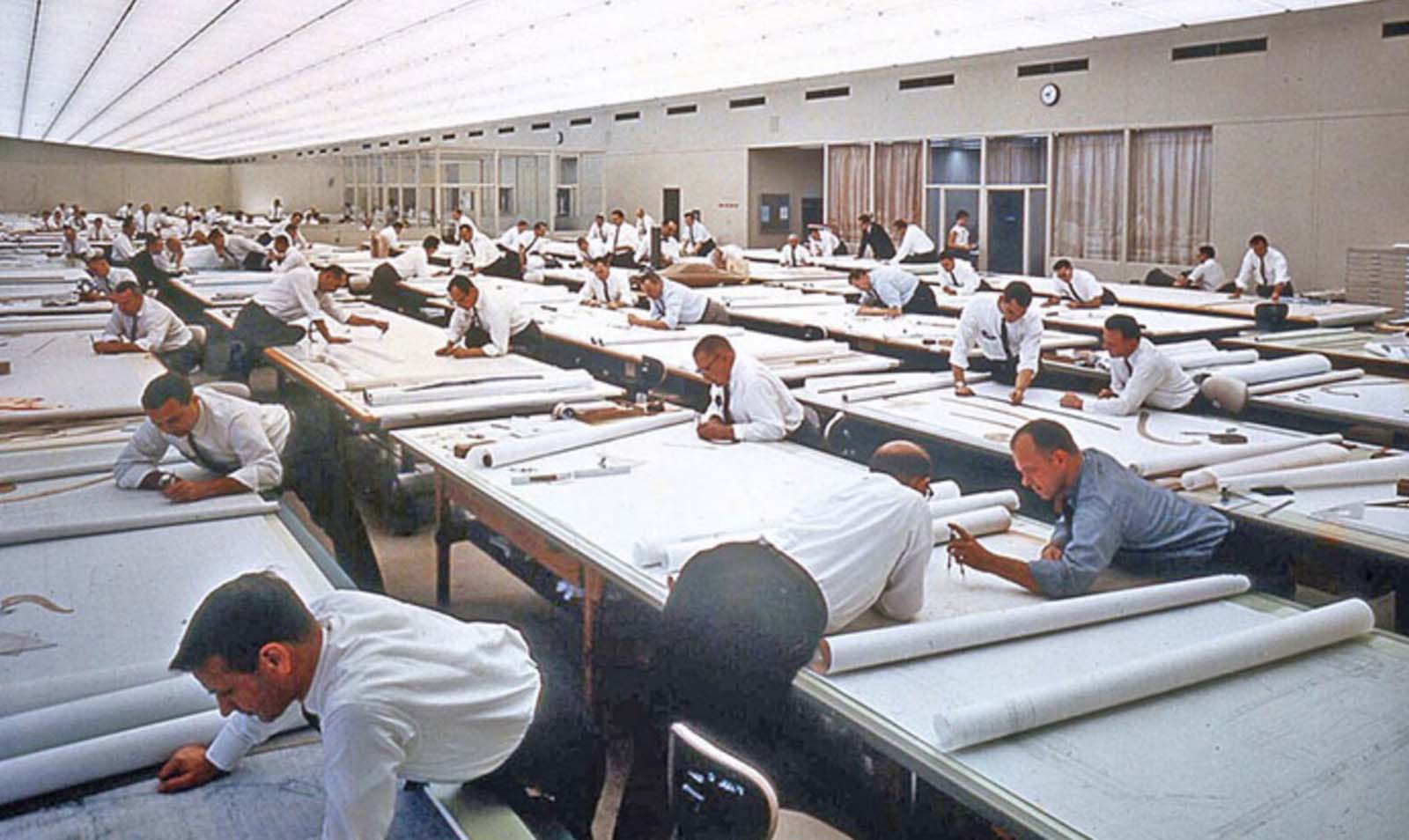
General Motors Technical Center in Warren, Michigan, sourced from www.rarehistoricalphotos.com.
AutoCAD:
AutoCAD software was developed by Autodesk and first released in 1982-83. However, AutoCAD was not the first computer-aided design (CAD) program. That distinction goes to Sketchpad, developed at MIT in the early 1960s, which allowed designers to interact with a screen using a light pen—primitive by today’s standards, but revolutionary at the time. Sketchpad proved that computers could be used not just for calculations, but also for creative design work.
AutoCAD represented a major shift in accessibility. It was the first widely adopted CAD application that could run on personal computers, rather than expensive mainframes or minicomputers. That democratization of design tools mirrored the shift we’re seeing today with AI coding assistants. You didn’t need to work for NASA to draft a technical schematic anymore; you just needed a PC and the software.
As AutoCAD evolved through the 90s and 2000s, it introduced 3D modeling, scripting through AutoLISP, and integration with building information modeling (BIM). AutoCAD became the industry standard, and the market exploded.
The CAD software market size estimate is ~$15B and growing around 7% per year. There are many players today, but Autodesk remains the industry titan.
AI Coding Assistants:
An LLM is a sophisticated word calculator, so naturally, code was an early application that demonstrated how AI could fundamentally change an industry. OpenAI unveiled ChatGPT near the end of 2022, nearly three years ago. What an adoption that was. ChatGPT had one million users within five days and 30 million within a couple of months after that. Today, OpenAI supports ~800 million active weekly users. That’s insane.
Back in 2022, around the same time Man discovered fire, developers started putting code into the chatbot prompts. “What is this error?” “How can I clean this up?” “Turn this into a batch script.” There was a lot of copy, paste, and test. We were making progress with this, but it wasn’t particularly efficient. The results were meh, and this type of work often caused more problems than it was worth. Creating more bugs while fixing one, or symptomatically treating a bug rather than addressing the root cause. Then…BOOM!
LLMs took off. New models were being released seemingly overnight that had more training parameters than the last. Meta began fiercely competing against OpenAI with their family of Llama-themed models. Researchers in the NLP space have a thing for releasing new techniques with cute names. ELMo and BERT are two of my faves. Llama is pretty good, too. OpenAI missed a big opportunity with GPT. Anyways, Meta released CodeLlama, an LLM tuned specifically to handle coding tasks. Mistral, a new European entrant to the LLM development race, had released a coding-specific LLM a few months prior.
Compute Evolution:
AutoCAD and today’s coding assistants both proliferated as compute became more accessible.
AutoCAD’s breakout moment came during the personal computer revolution of the 1980s. Previously, CAD tools required expensive minicomputers or mainframes, hardware that filled rooms and was managed by specialized IT staff. That meant CAD was locked away in universities, government labs, and Fortune 500 companies. Then came the IBM PC and Intel’s 8086 and 80286 processors. These chips packed enough punch to run AutoCAD locally, on a desktop, with no need for a $100,000 computer room. Engineers no longer had to share a single machine or wait in line for terminal access. With a reasonably priced machine, they could iterate and experiment freely, even at home.
Fast forward to today’s coding bots, and the trend repeats itself, except this time in the cloud. LLMs are staggeringly compute-intensive. Training models like OpenAI’s GPT-4 requires thousands of high-end GPUs running for months. Running the model in “inference,” which is what most of us do, still demands beefy servers outfitted with NVIDIA chips.
But here’s the trick: developers don’t need that hardware themselves. Thanks to hyperscale cloud providers like AWS (Bedrock), Google Cloud (VertexAI), and Microsoft’s Azure, all that power is just an API call away. Compute has become a utility. Pay-per-token means you rent the LLM by the sip, not the gallon. If you have a laptop and a bank account, you can develop a simple application for less than $20. Super basic code could even be less than a buck.
Where’s the value?:
What two things can you bet on that the CFO will ask as you plead for additional resources: Can I earn money with this? Does this free up my time to earn money somewhere else? The second of these two decision points is where you find scale, and it is the real value of AutoCAD and AI coding assistants. Companies measure this by studying a department’s throughput using labor productivity metrics such as per-unit output.
Imagine David’s boss procured a shiny new IBM desktop to replace his drafting station. It takes him longer to get started because he needs to learn how to use the software, but as time passes, he’s spending less time making revisions and more time automating design standards that are reused across projects. These templates can be used by other Engineers, and seemingly overnight, the team develops a rhythm of cranking out designs in half the time. The time spent redrawing or correcting ink smudges could be replaced by time spent iterating and designing. Revision cycles shrink and productivity rises. Designs become more complex, ambitious, and collaborative. AutoCAD files can be saved, shared, and modified by multiple people. Per-unit output goes through the roof. The machine would always create the line faster and with absolute precision.
Many would tell you we still have a little way to go before coding assistants reach absolute precision, but they’re getting pretty good. Remember the days when you would run through 10 pages of Google searches or 10 replies deep into a Stackoverflow thread? It wasn’t long ago, but those days are now a distant memory. Recently, StackOverflow reported that site traffic has been halved. Today, it’s more about mastering the prompt and how to interact with the LLM to achieve desired outcomes. Days of debugging and scouring the internet for reusable code can now be condensed into 10 minutes. Seriously, 10 minutes for what would have taken a week. This directly improves per-unit output figures. The reality is that if you’re a developer in today’s job market, this isn’t an option; it’s the expectation. The CFO doesn’t care about your natural ability to produce beautiful code. I’m sorry.
Freedom to be human:
Auguste Rodin’s The Thinker invokes a deeply introspective feeling in people and has remained a steady presence in culture since its inception. For over a century, this bronze sculpture has prompted people to pause for a moment, and well, just think. Rodin’s sculpture is so striking because it is so human.
Metrics like per-unit output cash checks, but a fundamental impact of both of these technologies is freeing up the worker to spend more time on abstract tasks. We are human! We’re designers, architects, engineers, and artists. We all express ourselves through our ideas and reveal to the world how we think through the way we carry ourselves day in and day out. David’s vision and approach to designing a bridge are not the same as his colleagues’. Perhaps David focuses on how the bridge beautifies the landscape, while others may favor a particular material.
The coding assistants provide a similar value. By handling the precision of the syntax, a developer spends more time designing an efficient program. There’s so much more than just writing code to building an automation or application. Great developers design programs that leverage reusable code blocks, manage compute resources efficiently, and keep individual scripts short and tidy. Many of the coding assistants are capable of performing these functions, but we still have to know how to interact with the bot to produce this type of result. To do so, we must know our style, our code libraries, and how we choose to present the program to the world. You don’t need to be a 10x programmer anymore- you need to be a 10x thinker, someone who knows what they want, what tools are available, and how to communicate objectives clearly to the machine.
After thoughts:
I came across www.rarehistoricalphotos.com while researching for this piece. It’s a fascinating website, and I particularly enjoyed the comments from people reminiscing on their time in similar environments. They were charming and helped me understand the extent of the pride and culture in their work. Check it out.
I didn’t realize at the time, but I wrote a post earlier this year that references a useful product development process also pioneered by Autodesk. There’s cool stuff happening over there.